Navigating Custom Branding: A Guide to Canva Thermal Labels for Small Business
For modern entrepreneurs, the distinction between a generic operation and a branded experience often comes down to the smallest details. This is where Canva Thermal Labels for Small Business enters the conversation as a pivotal tool for brand consistency. However, it is crucial to understand exactly what this resource entails before making a decision. Unlike traditional services that ship physical goods, this offering is strictly a digital item. No printed labels or cards will be mailed to your home. Instead, you are purchasing a set of editable templates designed to give you full creative control over your business communications.
The core value proposition lies in flexibility. Whether you are a boutique owner needing elegant thank-you notes or a manufacturer requiring precise thermal shipping labels, the ability to customize every element without relying on external designers is a significant advantage. This guide explores how these digital templates function, their strengths compared to other branding methods, and the specific scenarios where they offer the best return on investment.
Understanding the Digital-First Approach
The primary differentiator of Canva Thermal Labels for Small Business templates is their format. When you acquire this asset, you are not receiving a box of pre-printed stickers. You are receiving a .zip file containing PDF files and links to design resources within the Canva ecosystem. This approach fundamentally shifts the workflow from "ordering and waiting" to "designing and printing."
This model requires a shift in mindset for some business owners who prefer turnkey solutions. With a turnkey service, you provide text, and they handle the logistics. With a digital template, you become the project manager. You must have access to a printer or a local print shop. While this adds a step to the process, it removes the long lead times associated with custom printing orders. If you need 500 thank-you cards for a weekend sale, you can design them on Friday evening and have them ready by Saturday morning using your own equipment or a local courier.
The Role of Canva in Accessibility
A major factor in the popularity of these templates is the platform they are built on: Canva. Canva is a web-based graphic design tool that eliminates the need for expensive software installations like Adobe Illustrator or InDesign. This accessibility lowers the barrier to entry for small business owners who may lack technical design skills.
- No Installation Required: Since Canva runs in a web browser, you can edit your designs from any computer, tablet, or smartphone with an internet connection.
- Free Account Options: The basic version of Canva is free, meaning you do not necessarily need a paid subscription to utilize these templates effectively.
- Intuitive Interface: The drag-and-drop nature of the editor allows users to swap fonts, change color palettes, and adjust images with minimal learning curve.
However, this reliance on a third-party platform introduces a dependency. Your ability to edit the file is contingent upon Canva's continued availability and your own internet connectivity. For businesses operating in areas with unstable internet, this could present a temporary limitation compared to offline-capable software.
Comparing Formats: Thermal Labels vs. Standard Cards
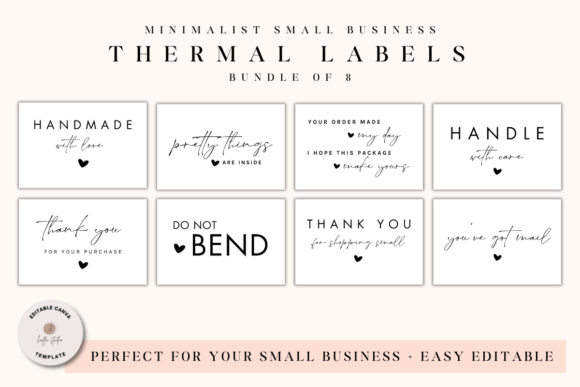
When evaluating Canva Thermal Labels for Small Business, it is important to distinguish between the two primary use cases often bundled in such collections: thermal shipping labels and standard thank-you cards. While they share the same design philosophy, their production requirements differ significantly.
Thermal Labels: These are typically used for shipping addresses or inventory management. They require specific printers (direct thermal or thermal transfer) that use heat-sensitive paper rather than ink cartridges. If you purchase a template designed for thermal printing, you must ensure your hardware supports the specific dimensions, usually 4x6 inches or similar sizes. The benefit here is speed and cost-efficiency for high-volume shipping, but the tradeoff is that thermal paper degrades over time if exposed to sunlight or heat.
Thank-You Cards: These fall under the category of marketing materials. The templates mentioned often include variations like 6x4 inch cards. These are versatile and can be printed on cardstock using a standard office inkjet or laser printer. The advantage is the tactile quality; a thick, textured card feels more premium than a flimsy thermal label. The tradeoff is the cost of paper and ink, which can add up if you are sending hundreds of personalized notes.
Size and Scalability
One of the standout features of these digital assets is their scalability. The documentation suggests that the templates come in standard sizes like 6x4 inches but can be resized. This is a critical capability for businesses that expand their operations. A template that works for a small batch of holiday gifts might need to be adjusted for a larger event or a different product line.
In contrast, pre-printed options from commercial vendors often lock you into fixed sizes. If you need a slightly different dimension, you must place a new order, wait for shipping, and pay for setup fees. With the digital template, resizing is instantaneous. You can take a 6x4 layout and adapt it for a square sticker or a vertical flyer with just a few clicks in the Canva editor.
Weighing the Tradeoffs: DIY vs. Professional Services
Choosing between a digital template and hiring a professional printing service is a common dilemma. To make an informed decision, one must weigh the costs of time, money, and quality.
The Cost Analysis
Digital templates offer a low upfront cost. You pay once for the file, and then you can print unlimited copies. Over time, this is significantly cheaper than ordering custom prints, especially for variable data (like changing names on each card). However, the "hidden" costs of DIY printing include electricity, ink or toner, and the price of high-quality paper. If you are printing on cheap paper at home, the result may look unprofessional compared to a glossy print from a pro shop.
Conversely, professional printing services charge per unit. While the per-unit cost drops with volume, there is always a minimum order quantity and a setup fee. For a small business testing a new product line, the commitment of ordering 500 units from a vendor can be financially risky. The digital template mitigates this risk, allowing you to print just ten cards to test the design before scaling up.
Quality Control and Consistency
When you use a digital template, you are responsible for color accuracy. Monitors display colors differently than printers, and paper types absorb ink differently. It is possible that the vibrant blue you see on your screen might appear slightly teal on the final print. Professional printers manage this calibration for you, ensuring brand colors remain consistent across batches.
Furthermore, the finish of the material matters. A thermal label has a specific texture and feel that cannot be replicated with a home printer. If your brand identity relies on a specific premium feel, a digital template printed on standard office paper might not convey the right message. In this scenario, the best approach is often a hybrid: use the digital template to design the layout perfectly, then send the PDF to a professional service like Vistaprint or a local print shop to handle the physical production.
Strategic Use Cases and Limitations
So, when is Canva Thermal Labels for Small Business the right choice? It is ideal for agile businesses that need rapid iteration. Startups, seasonal sellers, and pop-up shops benefit immensely from the ability to tweak designs instantly. If a typo is found, or if a logo needs updating, you can correct it immediately without waiting for a new shipment.
It is also perfect for businesses that value personalization. Imagine a bakery that wants to include a handwritten-style note on every package. With a digital template, you can easily merge name lists or create individual variations. Pre-printed options generally lack this level of customization unless you opt for expensive variable data printing.
However, there are limitations. If you are a high-volume e-commerce seller processing thousands of orders daily, the time spent managing digital files and running a home printer may become a bottleneck. In such cases, investing in a dedicated thermal label printer with integrated software might be more efficient than manually editing templates for every single order. Additionally, if your brand guidelines are extremely strict regarding Pantone matching, the variability of consumer-grade printers might be a dealbreaker.
Making the Final Decision
Evaluating whether to invest in these digital templates comes down to your specific operational needs and technical comfort level. If you prioritize speed, customization, and low initial costs, and you are willing to manage the printing logistics yourself, then a Canva-based solution is a powerful asset.
On the other hand, if you prefer a hands-off approach where you simply receive finished goods, or if you require industrial-grade durability and color precision that home printers cannot guarantee, you may find better value in a fully outsourced printing service. Many savvy business owners actually combine both strategies: they use the digital template to maintain a library of evergreen designs for quick turnaround, while outsourcing bulk orders for major campaigns to ensure top-tier quality.
Ultimately, the power of Canva Thermal Labels for Small Business lies in its democratization of design. It puts the tools of professional branding directly into the hands of the creator, removing the gatekeepers and allowing for a more responsive, adaptive business model. By understanding the capabilities and constraints of this digital-first approach, you can determine if it fits seamlessly into your current workflow or if a different path is required.